Think of your hardest patient, because that is where your doctors start
We usually ask the clinic to give us a patient that is their hardest patient, the one with the most data behind them. Once the BAA is signed, that patient becomes the first test case. Nothing about them reaches us before then, so for the walkthrough you only need them in mind.
The three steps, one at a time
- First
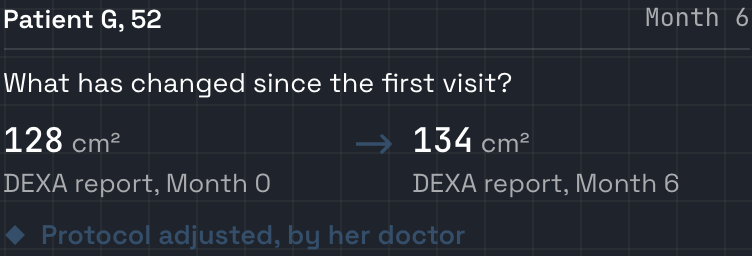
Clinical workflows
Your doctors, on Clinical Intelligence
A doctor asks that hardest patient’s whole record a question and gets the answer with the source behind it, and then asks the same of the patients they see next.
Your doctors prepare from it, and their charting stays where it is.
Clinical Intelligence: AI for longevity medicine - Next
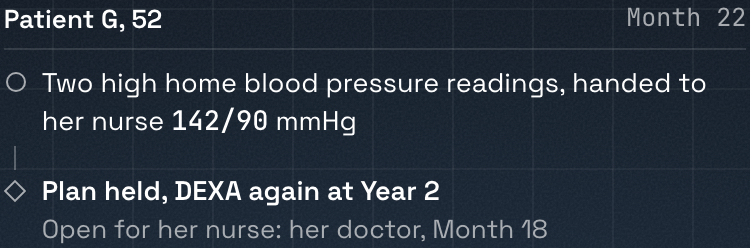
Nurse and patient coordination
Your nurses on Agentic CRM, and your patients on Patient AI
A nurse opens a patient and the protocol and the doctor’s last decision are already there, and patients get answers from their own record on the channel they choose.
Patient AI comes on one patient at a time, after a nurse reviews that patient’s profile.
Patient AI: the treatment companion - Then
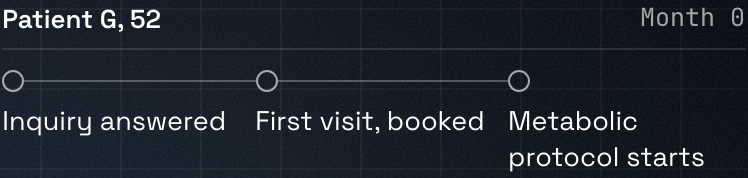
Lead capture
Your front desk, on Agentic CRM
Every inquiry lands on the same platform your doctors and nurses already work from, and a separate CRM can go.
Your front desk keeps the calendar and works inquiries from one inbox, each reply waits for one of your people, and any automatic message stays off until you switch it on.
Agentic CRM: scheduling and follow-up


Keep booking, billing and charting where they are, and bring each protocol onto iksa
Comes onto iksa
- Visit notes, and lab and genetics documents
- Wearable readings
- Patient messages
- The protocol, and each decision on it
- The follow-ups your doctors date
- Inquiries, and the relationship with each patient
Your records come across through your EHR or as documents, whichever your EHR allows.
Stays where it is
- Booking and the calendar
- Check-in
- Payments and billing
- Charting
- Orders and prescriptions
- Lab draws, where you draw them today
- Any panel a patient buys for themselves
What owners ask before they start on their hardest patient
Why our hardest patient?
Because the rest get easier.That patient has the widest spread of data and the most protocols at once, so your doctors can tell soonest whether this reads a patient the way they do. Once it reads that patient, everyone else on your panel asks less of it.
What does the first month involve?
We sign the BAA first, before any patient’s data reaches us, and go through the security review with whoever signs off at your clinic. Then your records come across, and your doctors learn iksa on that one hard patient, asking the questions they already carry about them.
We’re already stretched. Is this one more thing to implement?
It asks less of you than a new system would, because your doctors keep charting in your EHR and your front desk keeps the bookings in your calendar. The first thing that changes is how one doctor reads one hard patient.
What happens when a new doctor or nurse joins?
They learn in the product on your own patients, with each protocol and every decision on it already in front of them, and every release is checked against the training.
Who should be in the walkthrough?
You as owner or medical director, the doctor who knows that hardest patient best and your lead nurse. If you want them there, bring whoever handles security and whoever runs your front desk. That patient’s details wait for the BAA, so the call runs without them.
Have that patient in mind, and we’ll show what your doctors would ask first
Bring a protocol you run. We’ll walk one patient through it.