Patient AI, the patient’s side of the harness
A treatment companion that knows their protocol and history, and loops in their nurse when it matters
It is a concierge for every patient, fully loaded with the guidance their doctor approved for health coaching, side effect monitoring and ongoing check-ins, at any hour on the channel they choose. The doctor thinks of it as an extension of their own guidance, and the patient stays their patient.


- the patients each nurse can carry
- 4.3x
Routine questions are answered from each patient’s own plan, so a nurse’s day goes to what is clinical.
Your patients ask it what they’d ask their doctor
On the patient’s side, a plan can change from week to week, and the harness knows the one their doctor last changed and what they’ve reported since.
- A travel-day injection“My weekly injection falls on the day I fly to Tokyo. What does my plan say to do?” It tells them what the doctor wrote, and if the note doesn’t say, their nurse takes it.
- A side effect“Two days after my cell therapy infusion I still have a headache and a low fever. Is that normal?” It asks when the fever started and how high it has gone, and hands it to their nurse.
- A peptide“I read about a peptide for recovery. Can I add it to what I’m on?” That goes back to their doctor.
- A new lab result“My new ApoB is in. What does it mean against where I started?” It sets the number beside their first draw and their doctor’s target, with the reason from the doctor’s note.
- A screening finding“My whole-body MRI says a small lung nodule needs follow-up. Should I be worried?” Their nurse takes it, and the patient is told who will follow up.
- A change of dose“My levels came back low again. Can I go up on my dose?” That decision is their doctor’s, and the question goes to their nurse.
Patients get their doctor’s thinking at any hour and a nurse who already knows
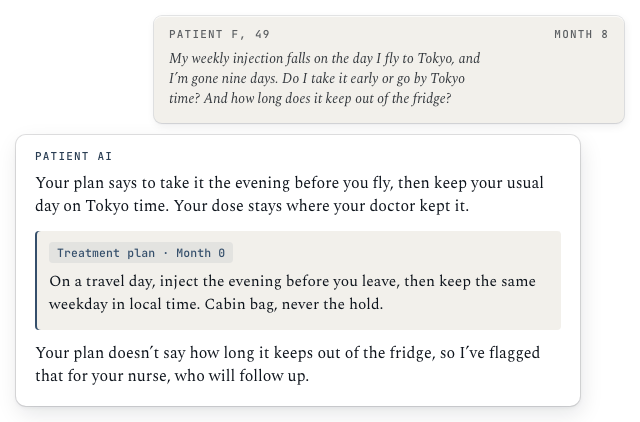
Every answer starts from what this patient’s doctor wrote, so it follows each change
It explains why they take what they take and what a term on their report means, and it reads a new result against where they started and their doctor’s target, from that patient’s record and the doctor’s own notes.
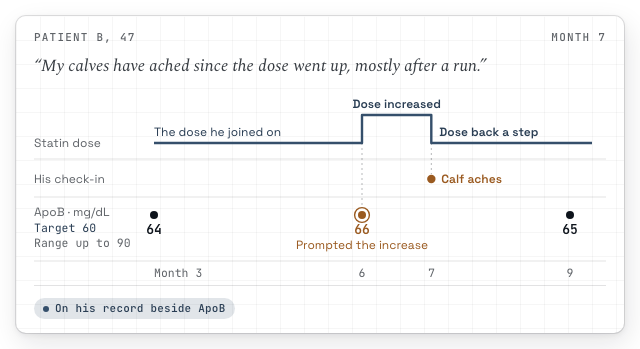
A rough week on a new dose reaches their record beside the markers
What the patient reports in a check-in sits on the same record as those markers, so the doctor can ask about both before the next visit.
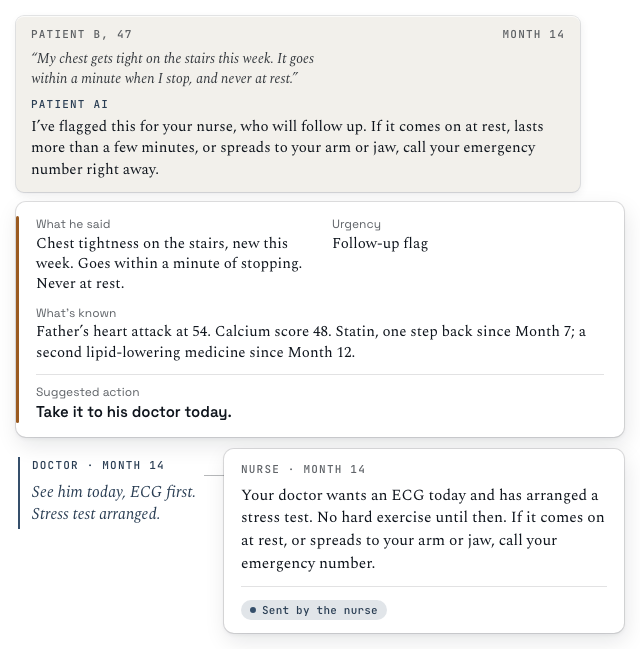
Anything clinical reaches their nurse with its urgency and what’s known
The patient is told who follows up, and the nurse sees what they said, the background from their record and a suggested next step. Emergency wording gets an immediate instruction to call the emergency number, with no questions first, and the hand-off goes to the doctor.


A patient who asks why their target is so low hears their doctor’s reason
The reason comes from the doctor’s note and the genetics report behind it, set beside the latest result.

It never diagnoses or doses, so you can hand it to your patient
You choose which patients it speaks to, one at a time. Think of the patient on stacked protocols who writes to your nurse at two in the morning, or the one who spends months away from the clinic.
A diagnosis
When a patient asks what a symptom means, it won’t reassure them with the odds, because that is still a diagnosis, and their nurse takes the question.
A dose
When a patient asks to go up, it tells them what the doctor’s note says and takes the request to their nurse.
A protocol
When a patient wants to stop or swap something, the change stays their doctor’s and their nurse hears that they asked.
Medicine from elsewhere
A study or a peptide the patient read about goes back to the doctor.
What an owner asks before it speaks to their first patient
Who answers my patients?
Patient AI does, at any hour, from that patient’s own record and the protocol their doctor wrote. A nurse reviews their profile by testing its replies first, so no one has to approve each reply, and a question goes to their nurse as soon as it turns clinical. It never changes a dose.
What counts as routine, and what goes to a person?
Routine is whatever the protocol already settles, why they take something, what their results and trends show and what a medical term means. A symptom, a worry about a result or a dose that isn’t working goes to their nurse, and anything that isn’t clinical goes to your team.
What happens when a patient has a side effect?
It asks when it started and how bad it is, and the hand-off reaches their nurse with those answers. Their nurse can pause it for that patient and reply from the hand-off, with a draft if they want one, and whatever happens to the dose is the doctor’s call.
Will an AI tell my patients something wrong?
Your patients already bring answers from a general AI that argues with the prescription and raises their anxiety. This is a white-labeled physician AI, carrying doctor-approved guidance, so it answers from the protocol the doctor wrote and their own record, and a question the protocol doesn’t settle goes to their nurse.
Is it a patient app they have to download?
No.Patient AI brings patient engagement to the channel they choose, with nothing new to install, and as their treatment companion it answers them from their own record in English or Thai.
Can we start with some patients?
Yes.Start with the ones you have in mind, and a nurse reviews each patient’s profile before it speaks to them. A patient you haven’t chosen gets no reply from it.
Clinical Intelligence: AI for longevity medicineAgentic CRM: scheduling and follow-upProtocol management softwarePeptide therapy
Think of the patients you’d start with, and see what they’d hear
Bring a protocol you run. We’ll walk one patient through it.