Clinical Intelligence, the doctor’s side of the harness
A research team behind every doctor, one that has read this patient’s whole record
On your side, the harness has read this patient’s notes, labs and genetics through every protocol they’ve been on and cites every answer. Before the visit you ask what has changed and open the source, while your nurse already works the safety labs you follow for each therapy.


Bring the questions you’d put to a research team
The research team follows your markers and targets month after month
Its lab tracking follows what this patient’s protocol says to watch, from the IGF‑1 on a growth-hormone-axis peptide to the retests you dated. The rigor you want reaches every patient. A critical value raises an alert with its report behind it, and a reported side effect goes to a person.
What changed
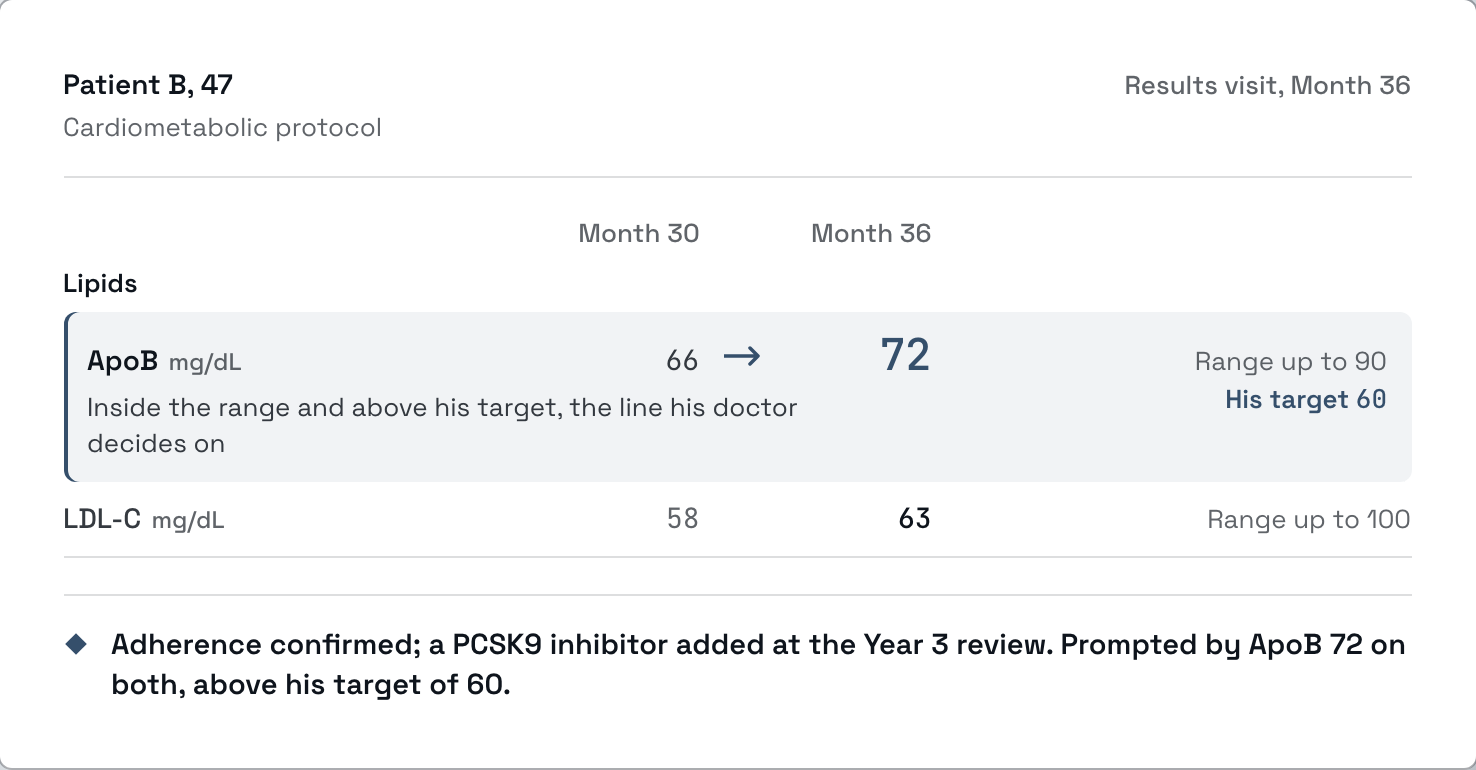
Each draw sits beside the last, so a change shows while still in range
Ask what has changed since the last visit and you read each result, from lipids and hormone levels to the lean mass an incretin takes, against its range and the one before it.
The source
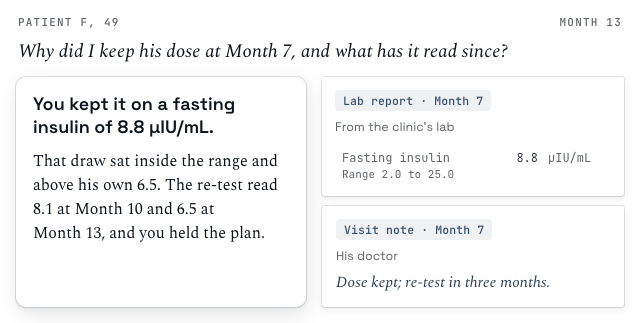
Every answer comes with its source, so you can disagree on the evidence
Ask about any marker, note or report and you get the finding, the reasoning behind it and its source, ranked by clinical priority.
Genetics
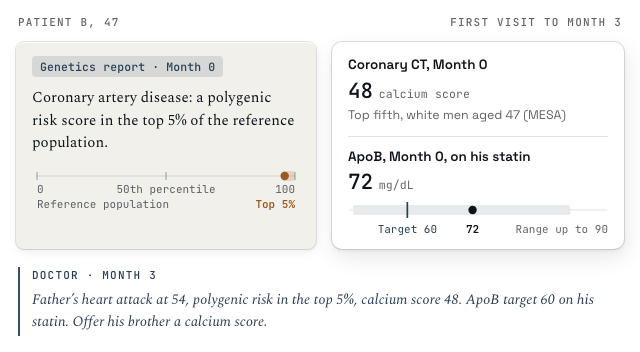
Ask whether a result has an inherited part, and the genetics report answers
The report’s own finding comes back beside the value it bears on. That can be an inherited lipid or heart trait, or how this patient’s body clears what they take.


When the record holds nothing, the research team says so
Anyone can buy a model, and personalized medicine is moving faster than general AI. A general model answers from yesterday’s medicine about a patient it has never met, and it doesn’t understand your protocols, while this one beats the general models because it answers from this patient’s record, inside the protocol you run. On every answer, the source’s words, origin and age come from the record and never from the model.

What it quotes
An answer quotes the record’s own wording, and anything the record doesn’t hold word for word is never shown as a quote.
Where it came from
Every answer cites its source, which opens on the document itself with its author, date and type.
How old it is
Each source carries how old it is, so a note from the first visit can’t pass as this month’s.
You decide in your own note, and the next answer starts from it
Your note carries the change and what it rests on, your nurse works from it, and three years on, you or a covering colleague can read why the course changed.

What you would ask any research team before relying on its answers
Who decides what changes in the protocol?
You do.Diagnosis, prescription, dose and every change to the protocol stay with you, in your own note and your own words.
What does it do when the chart has no answer?
It says so.Ask what the genetics report says on a patient with no report on record and it tells you the current record holds none and stops there. You know what’s missing before you decide.
If it’s wrong, who carries it?
The clinician who decides, as today.An answer is something you read and check against its source, and nothing changes for the patient until a clinician on your team changes it.
How is a lab value checked before I see it?
A value is checked against the report’s own page, along with its unit, range, flag and patient. One that fails is held under the name of what failed and never guessed, and if the report flags it critical, it still raises attention.
Will checking an answer take longer than reading the chart?
The answer arrives with the notes and reports it came from, so checking it means opening a source. You never rebuild the chart to find it.
Where do the answers come from?
This patient’s record, kept beside your EHR.Years of your notes and plans, the lab and genetics reports, the wearable readings and what the patient told the clinic, with each scan as your notes record it.
Is this clinical AI for longevity medicine?
Yes, on each patient’s own record.It is the clinical AI your doctors ask about one patient at a time, from longevity medicine to integrative oncology, and each answer cites the note or report it rests on.
My patient brings me an answer from a general AI. How do I reply?
With their record open.A general AI wasn’t specialized for what you prescribe and is often behind the times, so it leaves them more anxious than when they asked. Ask the same question here and you have their own results and your own targets, with the reports behind them, and what you say back is your judgment.
Does it write into my EHR?
It reads from it.The chart stays in your EHR with its visit notes, orders and prescriptions, and the decision you write in your note there is what the next answer starts from.
Agentic CRM: scheduling and follow-upPatient AI: the treatment companionProtocol management softwareCompare iksa with your EHRPeptide therapy
Bring a question about one of your patients, and watch their record answer it
Bring a protocol you run. We’ll walk one patient through it.