
On November 3, a16z published The State of Longevity (opens in a new tab), built on a survey of 500 randomly selected consumers in the U.S.
Its first finding frames the rest of the report: “Americans are taking their health into their own hands, spending more time, money, and energy on health and longevity.”
The report is just as clear about where the value goes. “As AI makes answers and interpretation cheaper, value will migrate to the companies that can figure out the action layer.”
Everyone is talking to health AIs in a vacuum
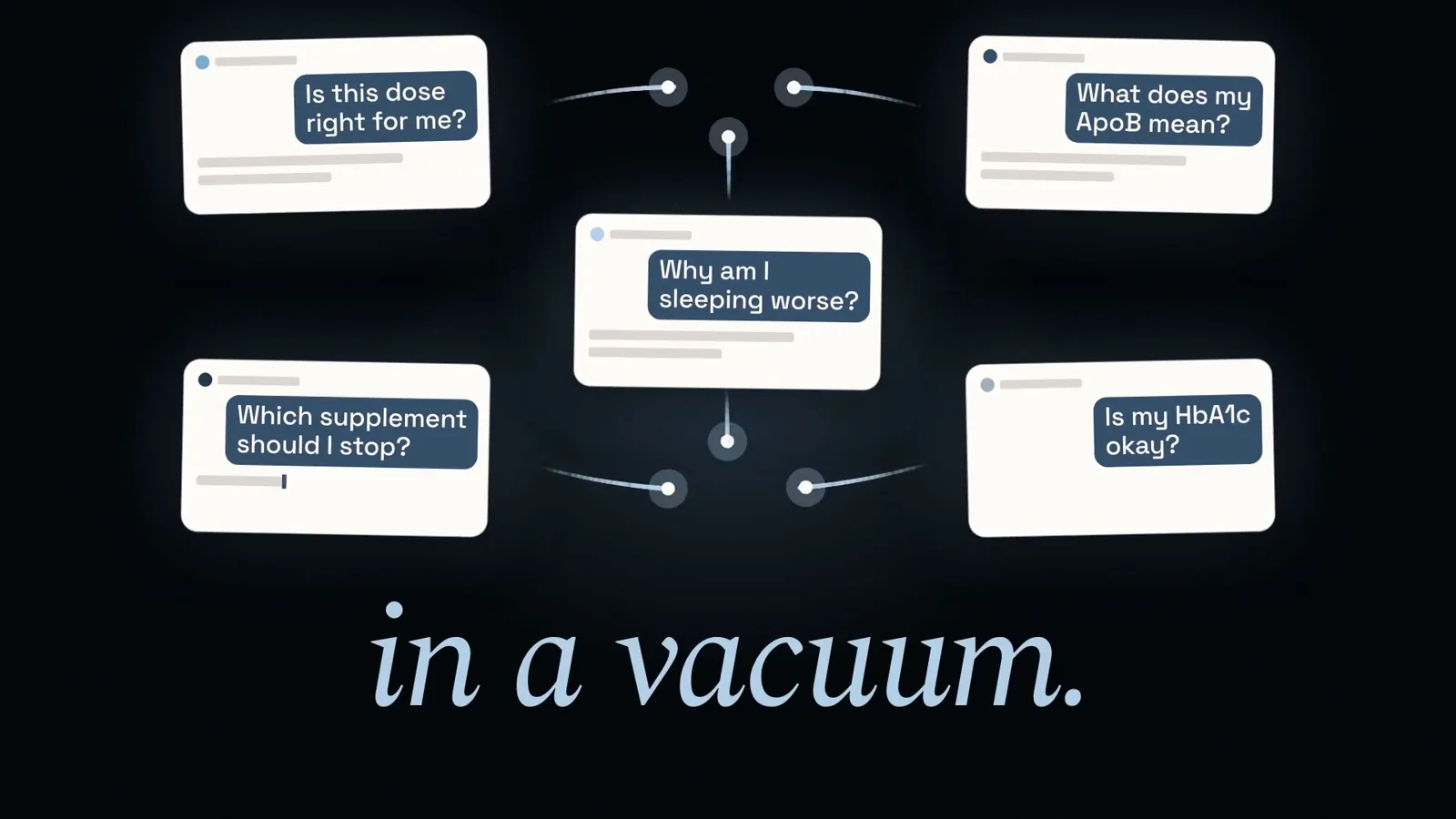
Answers are already cheap. A person can ask a health AI whether a dose is right for them, what their ApoB means or why they are sleeping worse, and get a fluent reply in seconds.
But everyone is talking to health AIs in a vacuum. The reply does not know their doctor, their labs, their wearable, their protocol or their nurse, and none of them hears the question.
The wearable numbers show the same gap from the device's side. In the survey, 54% of respondents use one, and 83% of those users check it every day.
Yet “55% of wearable users say their data has never prompted a behavior change or a doctor's visit.”
An answer without the person's own context is not an action, and data that reaches no clinician changes nothing.
Where people go to act
Personalized medicine has revolutionized the way healthcare is manufactured, delivered, and consumed. The report's trends show all three at once.
On peptides: “On the care delivery side, we could see a repeat of the GLP-1 cycle,” with dedicated prescribers first and existing healthcare companies adding peptides after them.
Its next observation is the one a clinic owner will recognize: “offering peptides may matter more for keeping existing patients from leaving than for attracting new ones.”
On cholesterol, it sees an opening for companies that “connect testing to personalized treatment” and “help patients access medications, and track their progress.”
Each of those is care that runs over months and years, with a clinician deciding along the way, and more of it now runs through a clinic people pay for themselves.
The B2B layer follows the consumer health layer. As people move from asking to acting, the clinics they act through need to carry the whole loop.
A connected ecosystem
We believe in a connected ecosystem for highly personalized, concierge medicine. In it, the question asked in a vacuum reaches the people and the record that can answer it.
Take one invented patient, Patient G, 52, in the second year of a concierge longevity program. At Month 13 she tells her treatment companion that sleep has been short this month.
Her nurse sees her wearable at 6.1 hours a night against her own 6.4 and passes it to her doctor.
At Month 14 her doctor adds a sleep plan, and it comes back to her companion as part of her protocol.
The question a health AI would have answered alone was answered with her doctor, her data and her protocol, and it changed what she does.
Running that loop for every patient is a lot to ask. The clinic is being asked to run a miniature clinical trial while also managing full time clinic volume, and its system was made to schedule appointments.
With no payer in between, the protocol is also the clinic's book of business, so each loop that closes in time is a patient who stays for the next protocol.
What we built, and why
So we built AI for clinical trial grade coordination, on all three sides of a patient's care.
iksa is the harness for n-of-1 medicine: trial-grade medicine built for individual cash-pay economics, one system of action for doctors, nurses, and patients so that concierge clinics can retain and scale better.
It starts with the physician‑patient relationship, where the protocol is personalized to one person, the patient’s treatment companion, set by the doctor, the nurse feedback loop, and ongoing refinement over time.
Underneath it is the clinical context platform: all the multimodal data, our context compression algorithms, and hundreds of protocols benchmarked against internal and external trials for evidence-based suggestions in personalized medicine.
The companion speaks under the clinic's own name, for the patients the clinic switches on. Each morning the agents show the nurse who needs a call and why, with a follow-up ready to send.
A person approves every follow-up the clinic sends, and every change to a dose or a protocol stays the doctor's decision. In production, the same team carries more patients: 4.3x patients per nurse, with 2.7x ROI.
Through our work with leading groups in regenerative medicine and longevity, one lesson repeats: what a patient brings in is only worth what the clinic does with it.
An invitation
The action layer a16z describes is being built now, by the people taking their health into their own hands, the companies that test and treat them, and the clinics where their protocols run.
Our vision is autonomous personalized medicine in dispersed micro-ecosystems globally operating at trial-grade.
If you run a clinic where the protocol is the product, we would be glad to compare notes.